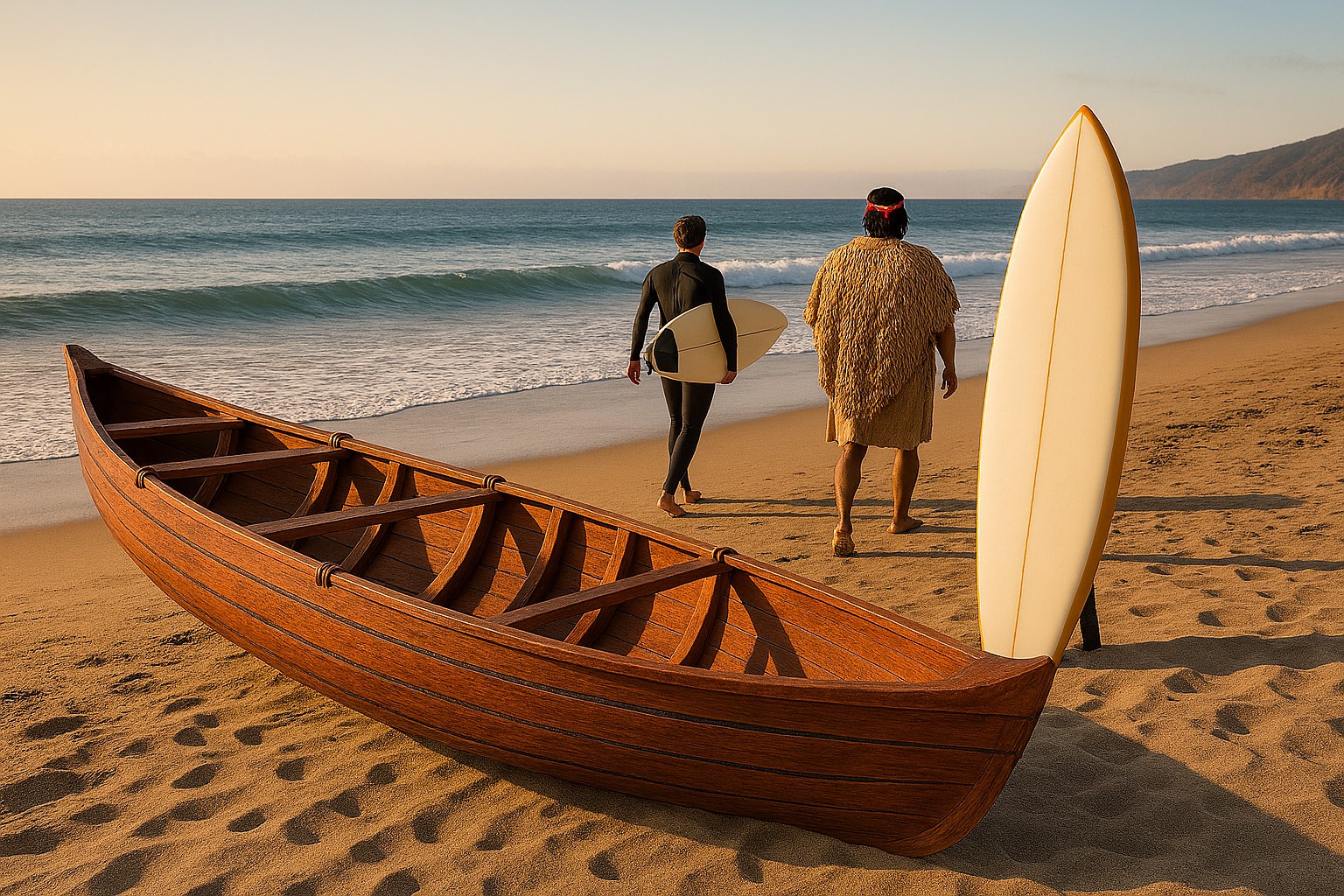
Today there exists a laid-back surfer town and popular beachside campsite along California’s Central Coast. Visitors flock to its scenic shores for sun, waves, and outdoor recreation, often unaware of the deep historical roots beneath the sand.
In the year 1542, the coastal village of Mishopshnow stood as a thriving hub of trade and craftsmanship along the shores of what is now Southern California. Nestled near rare natural tar pits, the community was uniquely positioned to harvest asphaltum or tar that served as a vital waterproofing agent for tools, baskets, and boats. This material, found in only a handful of locations worldwide, was not only a cornerstone of local industry but also a key commodity in regional trade networks that stretched across the Pacific coast.
The tar pits themselves were more than just a source of asphaltum. They were ancient windows into the past, preserving the remains of hundreds of Pleistocene-era creatures including mammoths, saber-toothed cats, and giant sloths, all whose bones lay entombed in the sticky earth. These natural archives silently testified to the deep time that shaped the land long before human settlement.
On August 15, 1542, Mishopshnow’s quiet prosperity was briefly interrupted by the arrival of a European ship sailing northward along the coast. This vessel, part of one of the earliest European expeditions to the region, marked a moment of contact between two worlds. Though the encounter was brief and the travelers continued on their journey, it was a precursor of the sweeping changes that would eventually reshape the continent.
Fast forward 227 years to August 17, 1769—nearly to the day of the earlier encounter. In the same village, two artisans began their morning by engaging in a tradition that had been perfected over millennia: the construction of tomols, sleek ocean-going canoes. These vessels, crafted from redwood planks gathered as driftwood and bound with natural adhesives like asphaltum, represented one of the most sophisticated maritime technologies in pre-Columbian North America.
That same day, explorers arrived in the region. As they passed through Mishopshnow, they observed these artisans at work, meticulously shaping and assembling the tomols. One of them recorded the encounter in his journal, noting the remarkable craftsmanship and the use of tar-like substances in the construction process. They were deeply impressed by the technological sophistication, particularly their ability to build seaworthy vessels without nails or European tools.
This moment of observation would leave a lasting impression. It was a rare instance in which European explorers acknowledged and admired Indigenous technology, rather than dismissing it. The soldiers, impressed by the carpentry skills, began referring to the site as "La Carpinteria", meaning "The Carpenter's Shop” in honor of these two skilled canoe builders. This name was later formalized and endures today as the modern city of Carpinteria.
The tomol was more than a boat—it was a symbol of ingenuity, cultural identity, and connection. With it, these navigated the channel waters, traded with neighboring communities, and maintained ties with islands offshore. These two artisans building the tomol possessed a craftsmanship that was passed down through generations, a sacred skill honed by time and tradition.
Following this period, Mishopshnow entered a new chapter shaped by colonization. With the establishment of nearby missions, including Mission Santa Barbara in 1782, many villagers were relocated and integrated into its system. They were taught and subjected to new social structures. This led to the erosion of traditional lifeways, including the maritime culture.
The story of Mishopshnow is not merely one of trade or technology, it is a legacy of a people deeply connected to their land and sea. From the ancient tar pits to the elegant tomols, the village stood as a beacon of innovation and continuity in a world on the cusp of transformation.
Thousands of visitors are drawn to this beautiful beach town each year. Many return time and again, compelled by something they can’t quite name. A sort of quiet pull, a sense of connection. Perhaps it’s the echo of an ancient history that still stirs the hearts of those who walk these shores. I count myself among them when walking past Tar Pits.